
Market Insight – The Unloved Bull Market Rolls On
Summary:
- US equities kept rising despite a weaker jobs market. The S&P 500 gained around 3.6% and reached another record high, even as July payrolls fell by 23,000 and average job creation over the past three months slowed to roughly 20,000 a month. This makes the Fed’s task harder if employment weakens while inflation stays elevated.
- Strong earnings remain the main support for the bull market. Around 86% of reporting S&P 500 companies have beaten expectations and headline earnings growth is above 50%. Even excluding the exceptional gains recorded by Alphabet and Amazon, underlying earnings growth is still around 32%.
- AI spending is spreading beyond the major technology companies. Investment is increasingly reaching construction, power, cooling, networking and electrical equipment. Caterpillar illustrated this trend with revenues up 24% and its order backlog rising above $72 billion, although much of this activity still ultimately depends on continued AI capital spending.
- Geopolitical and trade risks remain important, but have not yet derailed growth. Progress towards a technical arrangement around the Strait of Hormuz has reduced some immediate energy concerns, although it is far from a peace settlement. Meanwhile, Chinese exports rose almost 24% year-on-year, supported by advanced manufacturing and technology demand, while China’s domestic economy remains much weaker.
- UK fiscal policy is becoming a bigger market issue. The government may have more accounting flexibility to borrow for certain investments, but this does not remove the underlying economic constraint. Ultimately, gilt investors will determine how much additional borrowing can be absorbed without pushing yields materially higher.
Full market insight:
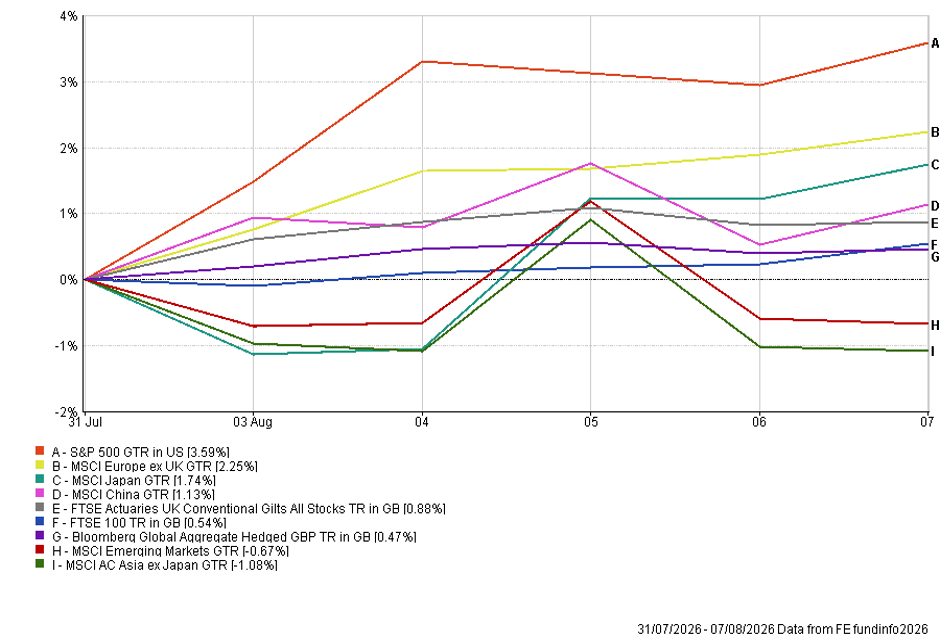
There was something rather appropriate about the way markets finished the week. On Friday we discovered that the US economy had actually lost jobs in July and the S&P 500 responded by closing at another record high. It capped a remarkably strong week, with the S&P gaining around 3.6%, Europe ex-UK up 2.3% and Japan 1.7%. Bonds joined in as well, with UK gilts gaining almost 0.9% and global bonds around 0.5%. China also gained around 1.1%, although emerging markets and Asia ex-Japan slipped by roughly 0.7% and 1.1% respectively, so the strength was broad across developed markets rather than entirely universal. It is an unusual combination: equities celebrating very strong corporate earnings at precisely the same time as government bonds celebrate weaker employment. But then this has been an unusual bull market from the beginning.
It also remains a remarkably unloved bull market in the commentary, if somewhat less so in positioning. Institutional investors have become materially more bullish over the summer, but every few weeks another apparently compelling reason emerges why the rally cannot continue: valuations are too high, AI spending is unsustainable, bond yields are too high, Trump is about to start another trade war, Iran will close the Strait of Hormuz or inflation is about to accelerate again. Eventually one or more of these concerns will cause trouble, but so far corporate profits and a surprisingly resilient global economy have proved more important. The wall of worry is certainly still there; markets just keep climbing it. Indeed, our weekly commentary dated 5 July 2026 made a similar point: increasingly sophisticated questions about AI, valuations and the durability of investment looked more like healthy features of a maturing bull market than evidence that the cycle itself was ending.
A crack in the US jobs market
Friday’s employment report was genuinely weak. Non-farm payrolls fell by 23,000 in July against expectations for an increase of around 80,000, while May and June were revised down by a combined 103,000. Average payroll growth over the past three months has therefore fallen to only around 20,000 a month. The unemployment rate edged lower to 4.1%, but largely for the wrong reason as labour-force participation declined. There were mitigating factors, including sizeable losses in local government education where summer seasonal adjustment can be problematic, while private-sector employment still increased. This still looks more like a “slow hire, slow fire” labour market than an economy suddenly falling into recession.
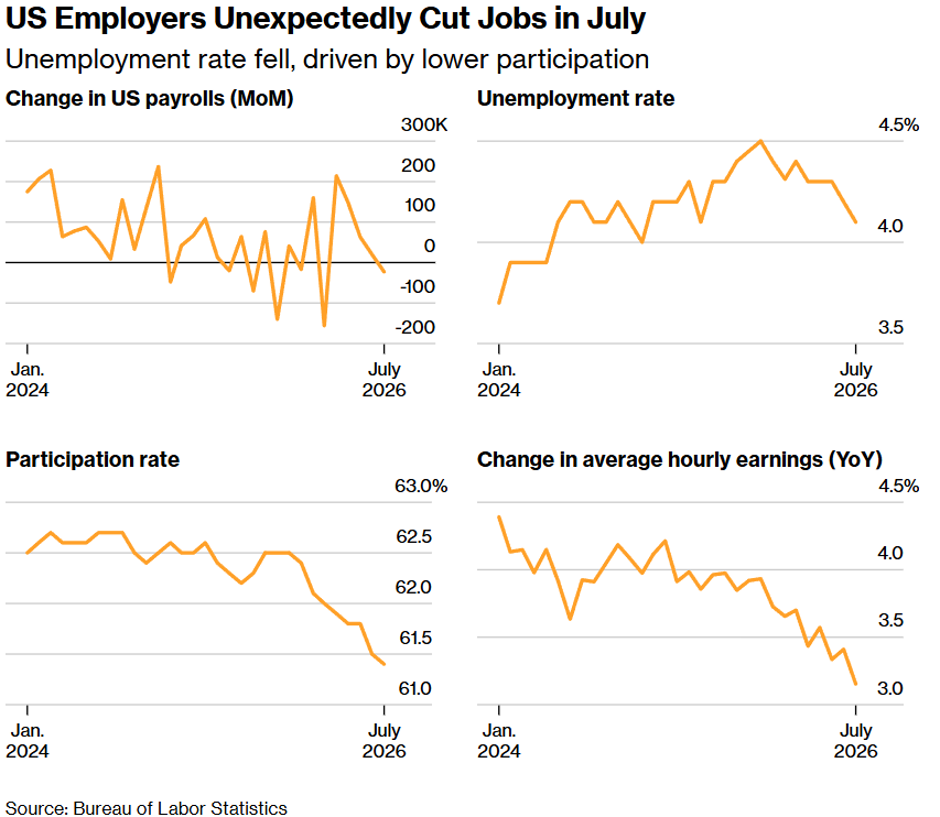
The broader economy does not look particularly recessionary either. Services activity remains in expansion territory and consumer spending has continued to hold up reasonably well. There is a similar tension in the survey data. The ISM services index remained comfortably expansionary at 54.1, but its employment component fell back to 47.4 while the prices index rose to 70.3. Growth has not disappeared, but the Fed’s employment and inflation objectives are beginning to pull in opposite directions. Nevertheless, Friday changes the discussion at the Federal Reserve. Until now the Fed has been able to concentrate predominantly on inflation; a noticeably softer labour market makes that harder. Market-implied odds of a September rate rise fell to around 44-45%, from the mid-50s immediately before the report, while Treasury yields moved lower and the dollar weakened. The uncomfortable scenario from here would be employment weakening while inflation remains stubbornly high, leaving the Fed with two competing problems rather than one.
War on, war off and repeat …
The Iran conflict increasingly resembles a dangerous game of stop-start diplomacy, and oil prices have swung accordingly. At the centre of the latest negotiations is the Strait of Hormuz, where Iran and Oman appear close to agreeing a technical framework for navigation. That is progress, but Tehran has made clear that the arrangement would not by itself fully reopen the Strait; the wider US-Iran conditions remain unresolved. US officials were sounding more optimistic by the end of the week, but the detail remains problematic. Iran wants to retain significant control over traffic through the Strait, while Washington has made clear that it will not accept Tehran effectively deciding which vessels can use one of the world’s most important shipping routes.
This is emphatically not a peace settlement. It looks more like both sides searching for a sufficiently vague compromise that allows them to stop shooting at one another without resolving the underlying dispute. Markets are, for now, willing to believe the fudge, with Brent ending the week around $82. The global economy can live reasonably comfortably with oil in the mid-$70s or low-$80s; what it cannot comfortably absorb is another sustained interruption to Hormuz. With the US midterms approaching, Trump also has very little incentive to provoke another surge in gasoline prices. That may provide a useful constraint over the next few months, although what happens after November could be a different matter. As we noted in our weekly commentary dated 12 July 2026, the more useful market test is the physical evidence – tanker movements, LNG flows, insurance costs and the oil price – rather than the latest diplomatic headline.
Profits explain quite a lot
If there is one reason not to become too gloomy about equities, it remains earnings. With around 88% of S&P 500 companies having reported, 86% have beaten expectations and headline earnings growth is running above 50%. Those figures need a substantial health warning because Alphabet recorded roughly $98 billion of largely unrealised investment gains while Amazon booked another $53 billion, mainly from its investment in Anthropic. Strip those two out and S&P earnings growth falls to around 32%, while the aggregate earnings surprise falls to around 11%.
Oddly, the cleaned-up figures are probably more reassuring than the headlines. Thirty-two per cent earnings growth across the S&P after removing those enormous accounting gains, is genuinely exceptional. Ten of the eleven sectors are growing earnings, eight are delivering double-digit growth and every sector is producing positive revenue growth. Overall revenues are rising by around 15%. Despite record share prices, the S&P’s forward P/E has actually slipped from around 20.4 times at the end of June to approximately 20 times today. That is certainly not cheap, but earnings have risen faster than share prices, which is a healthier picture than a bull market driven purely by multiple expansion. The caveat is that breadth and concentration are not quite the same thing. Earnings are growing across most of the market, but the incremental acceleration in index-level profits remains unusually concentrated, leaving the S&P sensitive to any change in the AI spending cycle.
The AI investment boom is also continuing to broaden. Palantir produced another extraordinary quarter and AMD’s data-centre revenues more than doubled, but some of the more interesting evidence is appearing away from the obvious technology names. Caterpillar reported revenues up 24%, booked another $9.4 billion of orders and took its backlog above $72 billion, with strong demand for construction equipment and backup power increasingly connected to data-centre infrastructure. We have talked before about the different stages of the AI boom: first the chipmakers, then the hyperscalers, and now spending spreading into networking, power generation, cooling, electrical equipment, construction and software. The picks-and-shovels opportunity appears to be broadening rather than disappearing. That is genuine broadening within the AI ecosystem, although not necessarily diversification away from the AI cycle: more industries are benefiting, but many remain dependent on the same underlying capital-spending boom. Our weekly commentary dated 12 July 2026 drew an important distinction here: broadening within AI – from processors into memory, equipment, power and infrastructure – is constructive, but it is not the same thing as broadening across sectors and market capitalisations.
China prepares for the next round
China produced one of the more remarkable numbers of the week, with exports rising almost 24% year-on-year in July. Semiconductor and high-tech exports have been particularly strong and Chinese car exports continue to grow rapidly. Some of this reflects the same technology and infrastructure boom evident elsewhere, while some may also reflect front-loading ahead of the next phase of Trump’s tariff regime.
The US is preparing for a more aggressive trade confrontation across technology, critical minerals and strategically important supply chains. China appears equally determined not to dismantle the advanced manufacturing model behind its export success and is instead finding customers elsewhere. The weakness remains at home, where consumption and investment are considerably less impressive. There is a danger that export success allows Beijing to postpone the harder reforms required to increase household incomes and rebalance the economy towards consumption. For now, though, China’s export machine is proving considerably harder for Washington to contain than many expected.
Britain’s new fiscal experiment
Closer to home, an important argument is developing over how Prime Minister Andy Burnham intends to use the fiscal rules he inherited. Burnham said on entering Downing Street that he would retain the existing framework but use any “flexibility” available within it. Chancellor John Healey has been noticeably more careful, preferring to talk about there being “scope” for faster investment while stressing that welfare savings and reprioritisation of departmental spending may also be required. The difference between flexibility and scope might sound like Westminster wordplay, but the gilt market is listening. That sensitivity is not theoretical. On Burnham’s first day in Downing Street, 10-year gilt yields rose by more than eight basis points to just over 5%, with UK bonds underperforming their US and German counterparts as investors assessed the fiscal implications.
The issue goes back to Rachel Reeves’ 2024 changes to the fiscal framework. The stability rule still requires the current budget to be in surplus, but the investment rule now targets public sector net financial liabilities, or PSNFL. Borrowing used to acquire financial assets – such as loans or equity investments made through institutions including the National Wealth Fund and British Business Bank – can therefore receive more favourable treatment because the asset is recorded against the associated liability. Ordinary capital spending on physical infrastructure does not receive the same offset. In accounting terms this creates considerable room for manoeuvre. In economic terms, nothing has disappeared: the government still has to issue the gilts, investors still have to buy them and taxpayers still have to pay the interest.
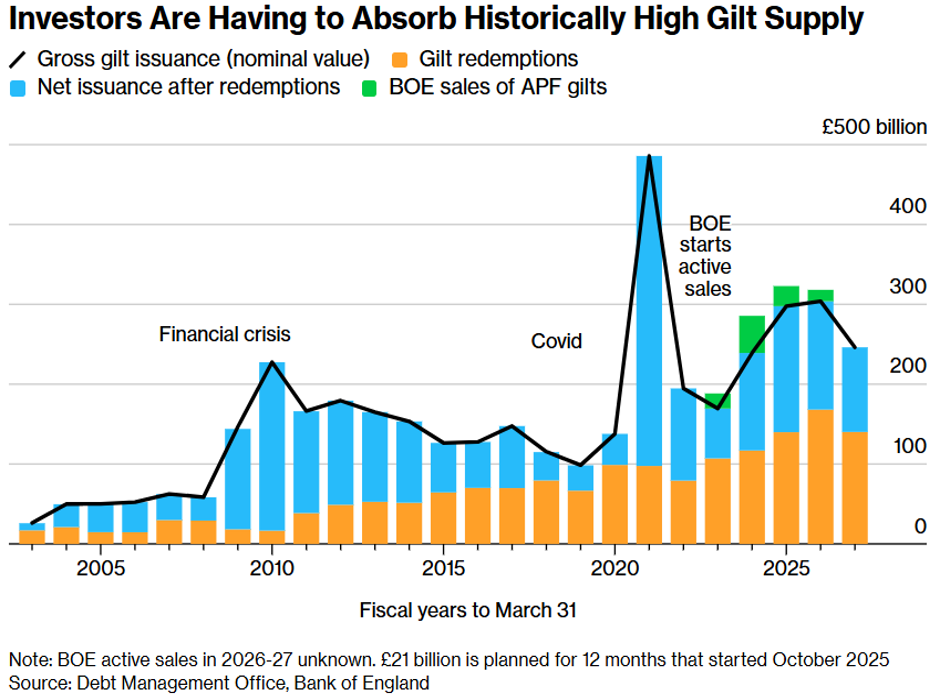
That explains Treasury nervousness about Burnham’s language. If investors conclude that “flexibility” means the government has found an accounting route around any meaningful borrowing constraint, the gilt market can impose its own through higher yields. There is also the more practical problem that there are only so many builders and so many bricks. Investment in Britain’s electricity grid, housing, transport and defence could genuinely improve productivity, but trying to force too much spending through the economy too quickly could simply raise construction costs, wages and inflation. There is a respectable case for borrowing to finance productive investment, but markets will want convincing that the projects really are growth enhancing rather than ordinary spending dressed up to get around the rules. The Treasury may have discovered fiscal space on a spreadsheet, but it has not discovered free money. In the end, Britain’s most effective fiscal rule may prove to be the one imposed by the gilt market.
This week…
This week gives us a useful test of this rather unusual market combination. US CPI on Wednesday is the obvious focus: a benign number alongside weaker employment would give the Fed more room to stay on hold, while an upside surprise would be much less comfortable. US producer prices follow on Thursday and retail sales on Friday. In the UK, second-quarter GDP arrives on Thursday at an interesting moment given the emerging fiscal debate, while China’s credit data should give us another indication of whether booming exports are being matched by any improvement at home.
Earnings are winding down, although CoreWeave, Super Micro, Cisco and Applied Materials should provide a few more clues about the durability of AI infrastructure spending. Iran remains the obvious wildcard, with a workable Hormuz agreement capable of removing another tail risk and a breakdown in talks putting oil straight back at the centre of markets. For now, however, profits are growing strongly, the world economy is still expanding and the list of reasons why markets ought to fall remains rather longer than the list of reasons they actually have.
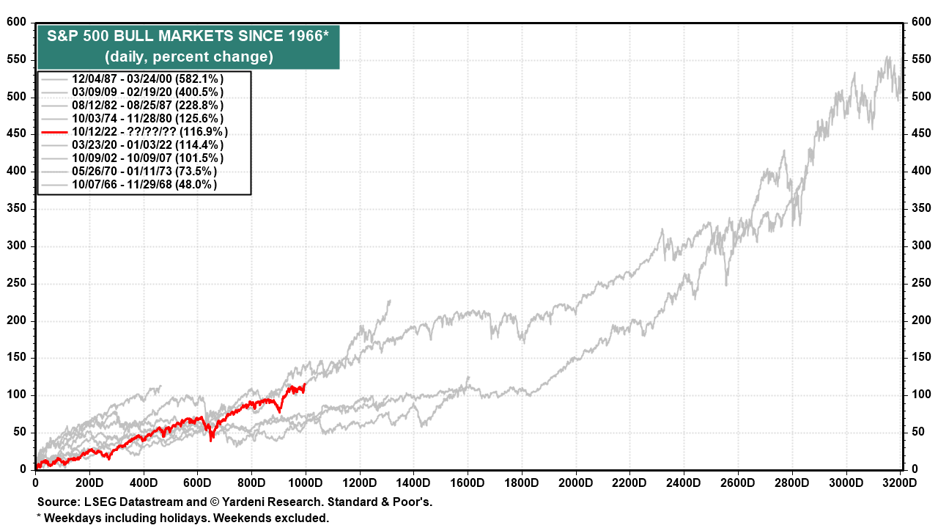
The unloved bull market rolls on and the S&P 500 is up 116.9% since it began on October 12, 2022 (chart). That ranks fifth among the nine bull markets shown since 1966. Anyone thinking of banking their profits now should just be aware of what might happen if an unloved bull market turns into a loved one!
Tom McGrath 09.08.2026
Edited by Ash Weston 09.08.2026