
Market Insight – Good fundamentals meet bad geopolitics
Summary:
- Markets were split rather than broadly risk-off. Better US inflation and earnings data were overshadowed by a sharp semiconductor sell-off. Asia and emerging markets suffered the largest falls, while the FTSE 100 benefited from its energy, commodity and defensive exposure.
- US inflation improved, but the problem has not disappeared. June CPI and PPI fell on the month, with shelter costs particularly subdued. However, annual inflation remained above target, and higher oil prices could reduce the Federal Reserve’s room to cut rates.
- The US earnings season has started strongly. Most companies reporting so far have beaten profit and revenue expectations, with growth extending beyond the largest technology firms. However, valuations and forecasts are already high, so investors are demanding strong guidance as well as good results.
- The AI trade is becoming more selective. Moonshot AI’s Kimi K3 model renewed concerns that advanced AI may be delivered at lower cost than markets had assumed. Demand for chips and data-centre investment remains strong, but investors are now focusing more closely on pricing power, profits and returns on capital.
- The Gulf conflict is now the main new risk to the outlook (again). Renewed US-Iran hostilities and disruption around the Strait of Hormuz could keep oil prices elevated and weaken the soft-landing case. This supports maintaining diversified exposure across energy, financials, industrials and less crowded international markets.
Full Insight
Market-performance figures refer to Friday’s close. The deaths of two US service personnel and the subsequent US strikes were confirmed after markets closed and are therefore not fully reflected in the weekly returns discussed below.
Markets have an irritating habit of ignoring the news you think ought to matter. Last week brought substantially better US inflation figures, another encouraging start to the corporate earnings season and few obvious signs that the American economy is falling over. Investors responded by driving the semiconductor sector into a bear market and producing some of the sharpest falls of the year across Asia. In fairness, markets had other things to worry about. The temporary peace around the Strait of Hormuz has broken down, American service personnel have been killed and the US and Iran are once again exchanging attacks across the Gulf. It was a week when the economic news improved, but the investment backdrop most certainly did not.
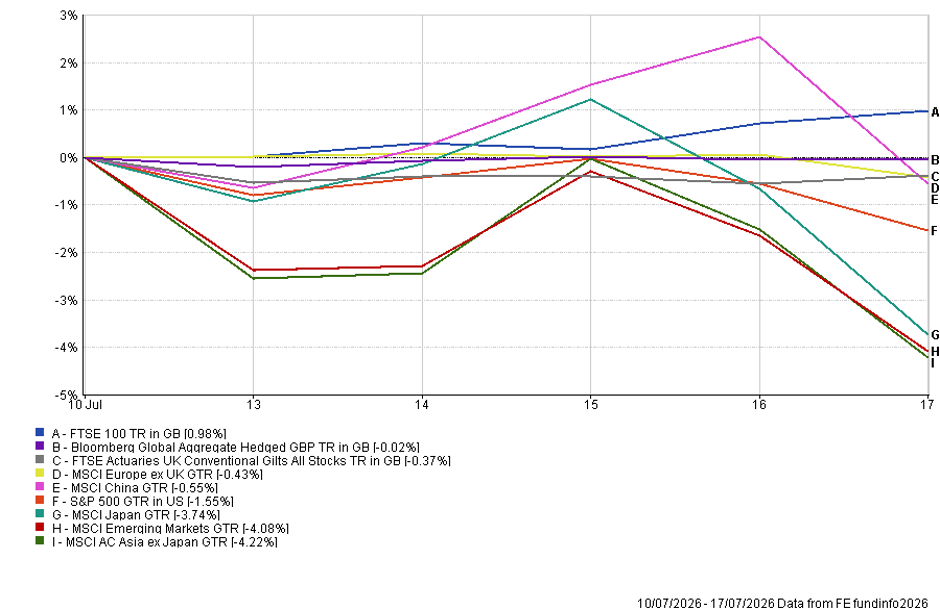
The resulting market performance was unusually divided. The FTSE 100 rose by just under 1%, helped by its energy, commodity and defensive exposure, while the S&P 500 fell 1.6%. The real damage was in Asia, with Japan down 3.7%, emerging markets losing 4.1% and Asia excluding Japan falling 4.2%. Europe and China declined much more modestly, while global bonds were broadly flat.
This was not an indiscriminate flight from every risky asset. It was a violent reversal in the areas most exposed to semiconductors and AI spending, combined with a move towards sectors that might benefit from higher oil prices or are simply less crowded.
Inflation: The US inflation figures were genuinely encouraging at the monthly level, although the annual picture remains less benign. Headline consumer prices fell by 0.4% in June, largely because energy prices dropped sharply, while core prices were unchanged. Core inflation slowed from 2.9% to 2.6% over the year, and shelter costs rose by only 0.1%, their smallest monthly increase since early 2021. Producer prices were also better behaved, falling 0.3% in June, with goods prices down 1.4%. Headline CPI was still 3.5% over the year and producer-price inflation remained at 5.5%, so June represented a welcome reversal in monthly momentum rather than a return to price stability.
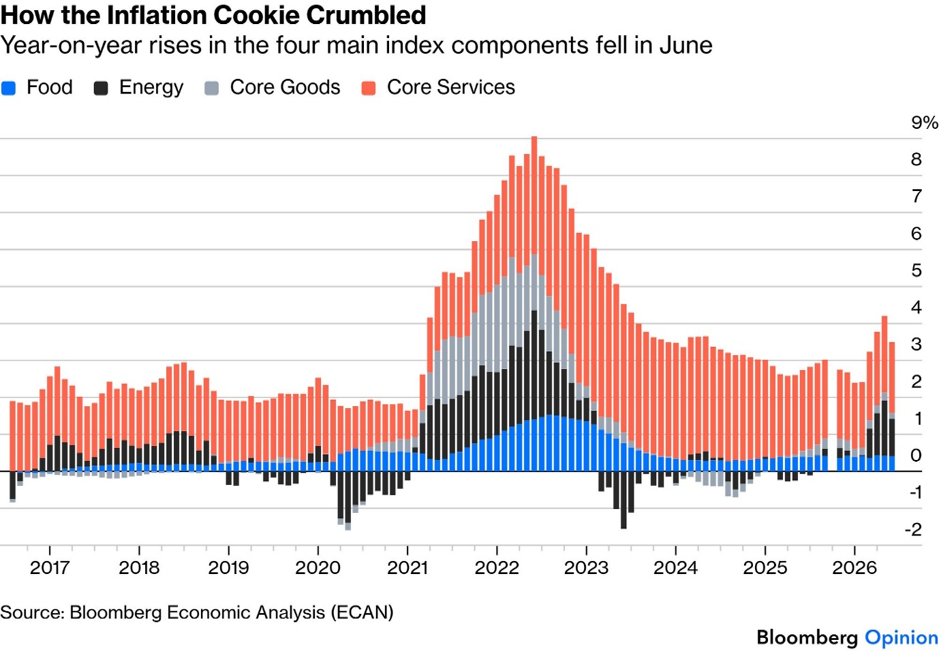
Unfortunately, the inflation figures came with a large asterisk. Much of the improvement in headline CPI reflected cheaper petrol and energy during the brief easing in Middle Eastern hostilities. Brent crude then rose sharply over the week, finishing at $88.10 a barrel, while West Texas Intermediate closed at $82.49.
This does not immediately reverse the progress in core inflation, and every rise in oil does not automatically produce a lasting inflation problem. It does, however, raise transport and manufacturing costs, squeeze household incomes and make central banks less comfortable about declaring victory. The inflation data gave the Federal Reserve more room, just as events in the Gulf started taking some of that room away.
Earnings: Corporate America continues to produce results that look considerably healthier than last week’s market reaction. Only 10% of the S&P 500 has reported, so we should resist getting carried away, but 88% of those companies have beaten earnings expectations and 85% have exceeded revenue forecasts. Earnings have come in 16.4% above estimates in aggregate, lifting the blended second-quarter growth rate to 24.7%. Revenue growth is running at 12.8%, which would be the strongest figure since 2022.
Financial companies have provided much of the early upside, an encouraging sign for credit quality, capital-markets activity and the wider economy. Ten of the eleven S&P sectors are expected to deliver earnings growth, with Energy, Information Technology and Materials leading the way. Technology still matters enormously, and concentration remains significant, but this is becoming a broader earnings story rather than one carried exclusively by a handful of companies. FactSet estimates that excluding Micron and Nvidia would reduce the quarter’s earnings-growth rate from 24.7% to 16.8%—still strong, but a useful reminder of how much the leading semiconductor companies continue to matter.
The problem is that expectations have risen almost as quickly as profits. Analysts are forecasting earnings growth of 24.5% for calendar 2026, while the market trades on 20.3 times forward earnings—modestly above its five-year average of 19.9 times and its ten-year average of 19.0 times. Simply beating estimates may no longer be sufficient. Investors want strong results, confident guidance and evidence that the vast sums being invested will eventually earn a decent return.
Semiconductors: That change of emphasis helps explain the extraordinary sell-off in semiconductor shares. The key US semiconductor index has now fallen 20% from its June record, technically placing the sector in a bear market after its strongest-ever quarter. The immediate catalyst was Kimi K3, a new 2.8-trillion-parameter open-weight model from China’s Moonshot AI. Its release revived the concern first raised by DeepSeek: that the cost of delivering increasingly capable AI may fall faster than the Western technology industry (and its investors) have assumed. If that proves true, it does not mean the world will require fewer AI applications, but it may mean that the relationship between better AI and ever-greater spending on computing power is less straightforward than investors had priced in.
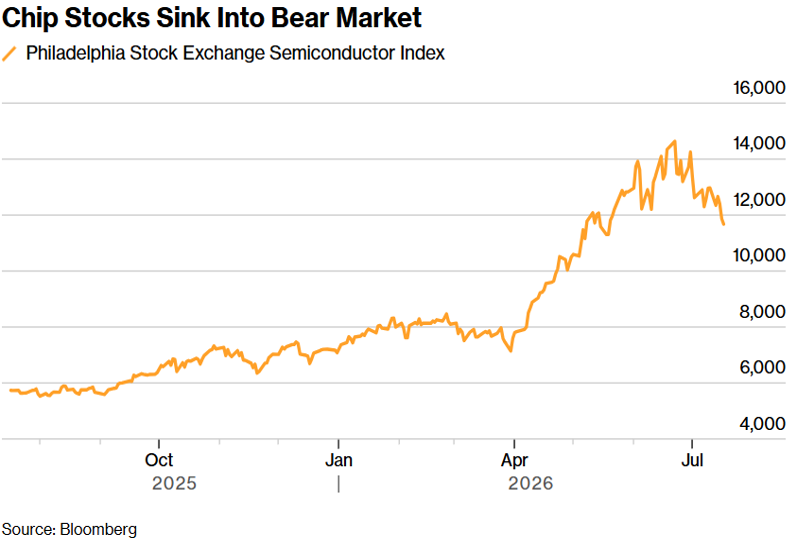
For the moment, there is little evidence in company results that underlying demand has collapsed. TSMC, Micron and the major equipment companies continue to report strong demand, and the hyperscalers have not announced a wholesale retreat from their investment plans. The sell-off tells us that positioning and valuations had become stretched, not necessarily that the AI cycle is finished.
Nevertheless, the market has moved into what we have previously called the accountability phase. The first stage of the AI boom rewarded almost anyone selling the picks and shovels. The next stage is likely to distinguish more harshly between companies with genuine pricing power and those exposed to overcapacity, falling costs or increasingly capable competition.
Asia: Asia ex Japan bore the brunt because Taiwan and Korea have become exceptionally concentrated in semiconductors and AI hardware. Japan also has meaningful exposure to chipmaking equipment, but its index is more diversified; its decline additionally reflected the wider effects of higher imported energy costs and global de-risking. When investors decided to reduce AI exposure, a stock-market correction rapidly became an index-level event.
By contrast, Alibaba, Tencent and some of the older Chinese internet platforms were relatively resilient. That is not yet evidence of a great rotation back into China, but it is a reminder that previously unloved assets can suddenly look safer when the market’s favourite trade becomes crowded.
Hormuz: The interim ceasefire has collapsed after renewed US strikes and Iranian retaliation, returning the Gulf to a dangerous cycle of attack and counterattack. Iranian missile and drone attacks in Jordan killed two American service members, left another missing and raised the reported US death toll in the conflict to 16. The United States launched further strikes in response, saying it intended both to punish the forces responsible and weaken Iran’s ability to threaten commercial shipping.
US strikes have widened to Iranian bridges, ports and other infrastructure, while Iranian attacks have hit military and civilian facilities across Gulf states, including oil and desalination infrastructure in Kuwait. Iran has also struck US assets in Qatar and continues to insist that ships seek its permission before passing through the strait.
Neither side may prefer a return to the earlier intensity of the conflict, but both are becoming caught in a familiar and dangerous cycle in which each attack creates the political requirement for another response. American casualties make it harder for President Trump to step back, while Iran’s leadership needs to demonstrate that attacks on its infrastructure carry a cost.
The worsening security situation is already affecting oil flows through Hormuz, while the possible involvement of the Houthis creates the additional threat of disruption in the Red Sea. Saudi Arabia can divert some exports towards the Red Sea port of Yanbu, but that solution becomes less useful if both routes are threatened simultaneously.
Oil: The oil market may still be showing too much faith that the disruption will remain manageable. The important indicators are not speeches or claims of victory but actual tanker movements, insurance availability, attacks on vessels and whether Gulf exporters can continue rerouting supplies. Oil does not need to reach $120 to cause difficulty. A sustained price near $90 would complicate the soft-landing story by lifting headline inflation, raising costs and reducing consumers’ disposable income.
Conversely, any genuine diplomatic off-ramp or improvement in shipping traffic would probably bring prices down quickly. The range of outcomes is wide, which is precisely why markets dislike it.
United Kingdom: Andy Burnham is due to become Prime Minister on Monday, with Shabana Mahmood expected (but not yet formally confirmed) to become Chancellor. Markets have responded positively to reports of her likely appointment, viewing it as a signal of continued fiscal caution, although her credibility with investors will ultimately depend on the policy detail. Burnham is likely to promise a more interventionist approach to housing, infrastructure and the cost of living, but financial markets will be interested in something rather less glamorous: whether the fiscal rules survive, how any new commitments will be paid for and whether government policy remains predictable.
His decision to scrap the digital identity scheme is an early attempt to demonstrate a change of priorities, although it is unlikely to transform the public finances on its own. The prospective Chancellor’s first task will be to convince investors that a change in political direction does not mean a loosening of fiscal discipline.
This week…
The coming week will be dominated by earnings, with Alphabet, Tesla, Texas Instruments, IBM and GE Vernova reporting on Wednesday, followed by Intel on Thursday. Alphabet will be the main event, with investors focused on cloud growth, AI revenues and, above all, whether management can demonstrate a clearer return from its huge capital-spending programme. After last week’s sell-off, even solid results may not be enough if guidance disappoints or hyperscalers sound less confident about future investment.
The economic calendar is lighter. UK employment data arrive on Tuesday and inflation on Wednesday, while the European Central Bank meets on Thursday. Rates are expected to remain unchanged. The decision itself is unlikely to surprise; the more important question is whether the ECB continues to treat the oil shock as temporary or begins preparing markets for a less benign inflation path later in the year. Christine Lagarde’s assessment of oil prices and inflation will therefore matter more than the decision itself. Flash business surveys on Friday should provide a useful reading of activity across Europe and Asia, while the Federal Reserve remains in its blackout period ahead of its meeting on 28 and 29 July.
Last week was painful, but it is worth being clear about what has and has not changed.
The US economy is still growing, inflation has improved and companies are producing strong profits. The AI investment cycle has not suddenly ended, although investors are quite reasonably demanding better evidence that the spending will generate adequate returns.
The genuinely new problem is the escalation in the Gulf and the renewed risk of a sustained energy shock. This is not an obvious moment to abandon equities or the longer-term AI theme, but it does reinforce the case for diversification. Energy, financials, industrials, selected Chinese internet companies, and less-crowded international markets can all provide potential sources of diversification and returns alongside technology.
After a period when almost everything appeared to depend on the same handful of chipmakers, some broadening may ultimately be healthy… even when it arrives rather violently.
Written by Tom McGrath 19.07.2026
Edited by Ash Weston 19.07.2026 alone.